
King of Men has spent years moving African music into European rooms — as the artist on the stage, the organiser who builds the night, and the man who decides what the room looks like when the lights go down. A conversation about packaging, risk, and where the singing came from.
There is a moment in every conversation with King of Men where the subject quietly changes. You ask him about a service — event organisation, artist promotion, decoration — and he answers about a feeling. Not the invoice. The feeling in the room at eleven at night when it is working.
“A show is not just about the artist,” he says. “It’s about packaging.”
That word does a lot of work for him. Packaging is not the flyer. It is everything that surrounds the four minutes an artist is actually singing: who announced the night and how loudly, what the poster looked like, which other promoters were asked to help push it, how the hall was dressed, who is on the microphone between sets, and — he comes back to this repeatedly — what the host is wearing.
“Your outfit has to be classic,” he says. “If you want to pull a crowd, you give yourself something fitted, something modelish. You can make it glistening, you can make it elegant, whatever you think. It’s classic.”
For a man who runs events for a living, this is not vanity. It is a working theory of why people come, and why they stay. He is describing a business where the product is not a performance but an evening, and where an evening either has weight or it does not.
The room is the product
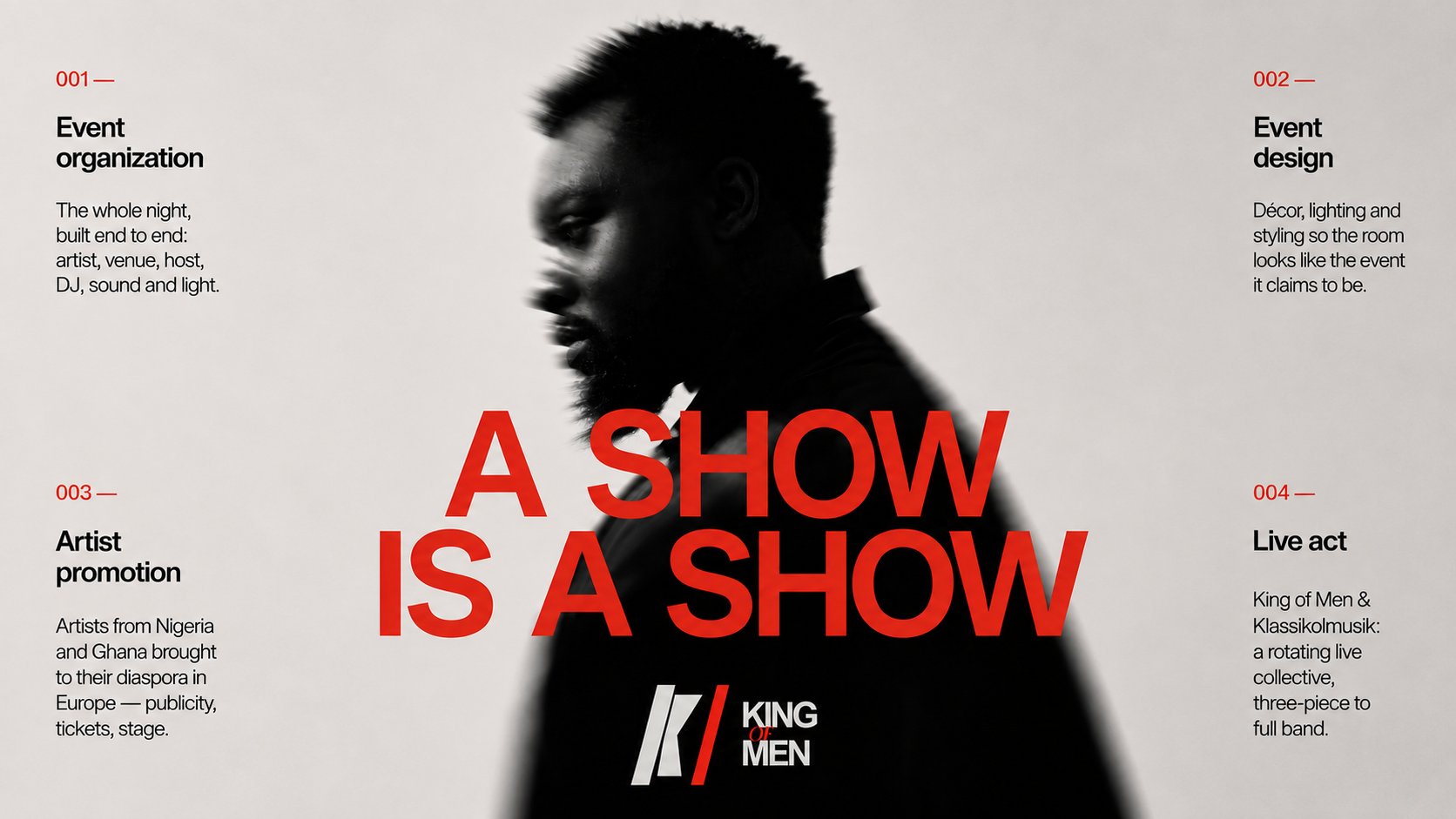
Solomon Abiodun — Johnny to most people who know him, King of Men on a poster — is based in Munich and was born in Nigeria. He is a registered Veranstalter, an event organiser, and he runs his events through his company, Klassikolmusik Entertainment, registered in Germany and in Nigeria. He performs. He books. He promotes. And, less obviously for a musician, he designs the rooms.
Ask him what a night needs and he gives a list, fast, as if reading off a load-in sheet:
“Decoration. Lighting. Good sound. Good DJ. Good hype man. Good MCs. Comedians, also — they can wake people up, exaggerate a little, get the room going.”
The comedians are the tell. A promoter who is only thinking about the headliner does not budget for a comedian. A promoter thinking about the ninety minutes before the headliner does. He is unusually clear that the gaps in a night are where nights are lost.
“If you don’t do this — if you don’t make them feel happy, feel like oh, this is a show — then you are not doing a show. People go home. Nothing happened here. So a show is a show. You have to give it a show. It starts with how you dress. It starts with how you speak to people in that moment. Give them drama. Shake it up.”
It is a philosophy that would be at home in hospitality or in theatre, and it is much closer to how a good festival producer talks than to how most independent artists talk. Most artists sell the song. He is selling the night the song happens in.
Where the money actually is
He is also, refreshingly, willing to say out loud how the money works — which is rarer in live music than it should be.
The mechanics, in his telling, are simple and unromantic. He brings an artist over. He organises the show. He pays the artist. He handles the publicity. Guests pay to come and see the artist he brought. Out of that, he settles what is owed.
“I pay the artist,” he says. “If I haven’t paid him in full before, if I owe him a balance, then I take it from what comes in at the end of the party and settle everything. Then I have my gain.”
And the bar. He mentions the bar the way a chef mentions salt — as the thing that quietly makes the whole plate work.
“If the room is happy, they buy a lot of drinks. You don’t even know. You make money from these drinks.”
That connects the aesthetics to the accounting in a way a lot of promoters never articulate. The lighting, the decoration, the hype man, the comedian — those are not decoration in the budget sense. They are what keeps a room standing at the bar instead of drifting toward the coat check at half past eleven. Spend on the room, and the room spends back.
Then he says the thing that separates people who have actually run events from people who have only imagined running them.
“Sometimes you lose. Sometimes you gain. It’s one thing you have to be ready for. You have to expect disappointment.”
He does not say it heavily. He says it the way you say something you have already paid for, more than once, and made peace with.
“We found ourselves in choirs”
The music came first, and it came from the house.
“Most of my family are musicians,” he says. “Men and women. All of them talented. We are just blessed like that. Most of us didn’t learn this music anywhere. We found ourselves in choirs, in churches. Singing for God. That’s the music we’re in today.”
It is worth sitting with that for a second, because it explains a lot about how he operates. He did not come up through a label system, a conservatory, or a management structure. He came up through a form where music is communal by default — where the point is not to stand out in front of the group but to hold the group together. Where nobody has a solo career, and everybody sings.
That instinct is all over his work now. His band is not a fixed lineup; it is a rotating group of musicians who come in depending on the night and the booking. Other artists put him in their songs — he mentions it almost in passing, as a form of thanks. “They sing me in their music, just to appreciate what I’ve done for them.”
Under his own name there is a small catalogue, including a track called “King of Men Salute,” recorded with features and a producer, released at the end of 2023. He is candid that recording is not what he is doing right now. The energy is going into the band, the live shows, and the artists he is moving.
“The music is part of me,” he says. “Part of my family.”

Both banks of the river
The most commercially interesting thing about King of Men is not any single service. It is the geography.
“I’m not just doing it in Nigeria, where I’m born from,” he says. “I’m doing it where I live now, in Germany. And beyond that, across Europe. I’ve been to many places. Paris. Italy — Naples.”
This is the part that is hard to replicate. Plenty of people in Munich can book a night. Plenty of people in Lagos or Benin City can find talent. Very few are standing on both banks at once, with a legal entity in Germany, real relationships in Nigeria, and enough experience to know what an artist actually needs when they land in a city where nobody knows their face yet.
His pitch to artists follows directly from that.
“People might not know you, that you do this,” he says. “At the time you want to be famous, to be popular — then bring out your talent. Show what you’ve got.”
So he brings them. He organises the show, pays the fee, does the publicity, sells the tickets, and hands them a room that has been built to make them look like they belong in it. For an artist making a first move into Europe, that combination — a stage, a crowd, and someone who has already absorbed the downside risk — is not a small thing. It is close to the whole thing.
He is also blunt that this is a numbers business over time, not a jackpot business. Some nights carry the ones that didn’t. You keep going because the next one might be the one that moves someone’s career.
 The elder in the room
He does not talk about competition. This is unusual enough in a genre built on flex that it registers immediately.
Nothing in the conversation is aimed at anyone else. There is no rival promoter, no scene politics, no complaint about who got booked instead of him. What there is, instead, is a running assumption that other people’s success is not subtracted from his — that if you bring someone over and they do well, that is the job done, not an opportunity missed.
It reads as an older instinct, and probably a church one: the group before the soloist. It also happens to be good business. The artists he brings over are the people most likely to recommend him to the next artist, and in a business run almost entirely on trust and phone calls, that is the only marketing that reliably compounds.
Near the end he cuts himself off, laughing, aware he could keep going.
“We can’t say everything,” he says. “If we say everything, we’ll be here forever.”
Which is, in its way, exactly the right instinct for a man whose entire craft is knowing when a room has had enough — and when to bring the lights up.
King of Men is Solomon Abiodun, a Munich-based artist and event organiser from Nigeria. He performs with a rotating band, organises African music events across Europe, and brings artists from Africa onto European stages through Klassikolmusik Entertainment.